
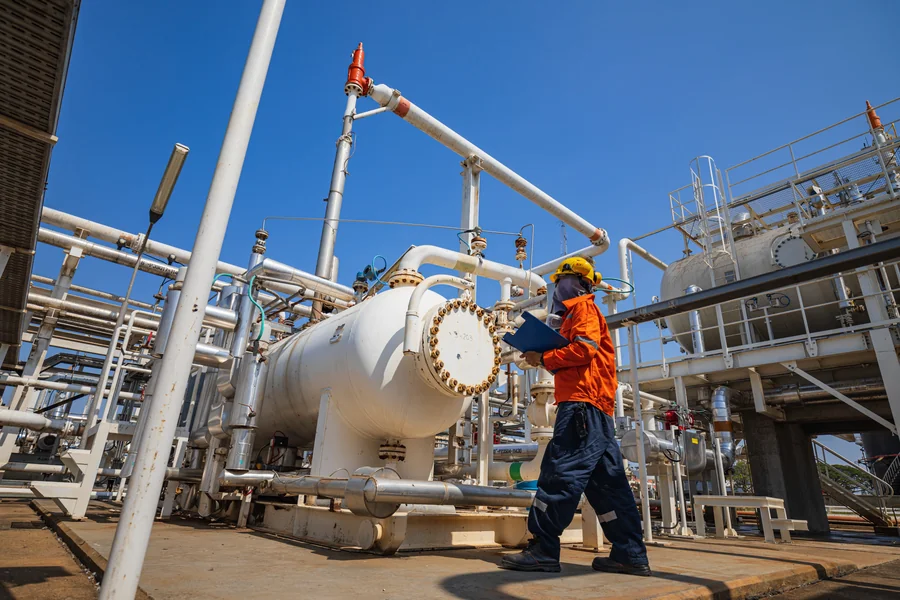
A pressure vessel can meet its specified capacity and still be poorly matched to the process around it. Material compatibility, temperature changes, nozzle placement, and maintenance access all affect its usefulness. When evaluating Sharp Eagle’s modular process skid systems and custom pressure vessels, buyers should define the vessel’s duty alongside the connected equipment. Offsite modular integration then allows the vessel, piping, instruments, and supporting structure to be assembled as a coordinated system.
Start with the Fluid and Its Behavior
A vessel specification should identify what the equipment will contain and how that material behaves during operation.
Relevant information includes:
- Fluid composition and potentially corrosive contaminants.
- Viscosity and suspended solids.
- Required working volume and vapor space.
- Heating, cooling, mixing, or separation duties.
- Cleaning methods and cleaning chemicals.
Working volume deserves particular attention. A vessel’s total internal capacity is not necessarily its usable batch capacity. Space may be needed for vapor, foaming, liquid expansion, or process internals.
Material selection likewise requires more detail than “stainless steel.” Suitability depends on the particular alloy, fluid chemistry, temperature, and service conditions.
Consider More Than Normal Operating Pressure
Normal production describes only part of the vessel’s duty. Startup, shutdown, cleaning, and credible process disturbances may introduce different pressure and temperature conditions.
For example, condensing vapor inside a closed vessel can create vacuum conditions. Equipment designed for internal pressure is not automatically suitable for that external-pressure load.
Repeated pressure or temperature changes may also influence fatigue requirements. These conditions should be established during engineering so that the mechanical design reflects the intended service.
Match Connections to the Surrounding Equipment
Nozzle locations influence piping length, instrument access, drainage, and maintenance.
A poorly positioned outlet may complicate the pump suction arrangement. Closely spaced connections may leave insufficient room for valves or insulation. Connected piping can also transfer loads into vessel nozzles as temperatures change.
Designing the vessel within the skid layout allows engineers to coordinate:
- Pipe routing and supports.
- Thermal movement and connection loads.
- Instrument and inspection access.
- Clearance for removing serviceable components.
A smaller footprint should not make routine maintenance impractical.
Specify Evidence of Suitability
Procurement documents should define the applicable design requirements, inspection scope, material records, and required test documentation.
Acceptance should address both mechanical integrity and the intended process duty. A pressure test provides evidence about the pressure boundary under specified test conditions; it does not demonstrate mixing quality or heat-transfer performance.
A well-specified vessel gives the modular system a sound starting point. Coordinating its duty, materials, connections, and access requirements before fabrication helps prevent an apparently suitable component from becoming a limitation on the complete process.