
We all have that folder on our desktop. It’s usually labeled “WIP” (Work in Progress), “Drafts,” or simply “Ideas.” Inside, there are dozens of video projects, game prototypes, and presentation decks that are almost good.
They have great visuals. The script is solid. The concept is strong. So, why are they sitting there, gathering digital dust?
In my experience talking to hundreds of creators, the roadblock is rarely the vision; it is the atmosphere. You can visualize the scene perfectly, but you cannot hear it. And because you can’t find the right sound to glue it all together, the emotional impact falls flat. You spend three hours scouring the internet for a track that matches your specific mood, you come up empty, and you lose the spark. The project dies in the “90% Complete” trap.
Audio is the invisible glue of storytelling. Without it, a horror movie is just people running around in the dark; a travel vlog is just a slideshow.
This is where the conversation about Artificial Intelligence usually misses the point. We talk about “replacing” artists, but we should be talking about empowering completion AI Song Generator is emerging as the ultimate cure for writer’s block, not by writing the story for you, but by providing the soundtrack that helps you finish it.
Velocity is the New Quality
The Friction of the Hunt
Creativity has a half-life. The longer it takes you to execute an idea, the less likely it is to happen.
In the traditional workflow, audio is a source of massive friction.
Let’s say you are editing a fast-paced montage of a cyberpunk city.
- You need a track that is aggressive, electronic, but has a slow breakdown in the middle.
- You visit a stock music site.
- You filter by “Electronic.” You get 50,000 results.
- You filter by “Aggressive.” You get 5,000 results.
- You listen to 20 tracks. None of them have the slow breakdown you need.
- You compromise. You pick a track that is “okay,” and you edit your video to fit the music, rather than the music fitting your video.
The Fluidity of Generation
Generative audio removes this friction. It aligns the speed of asset creation with the speed of your thought process.
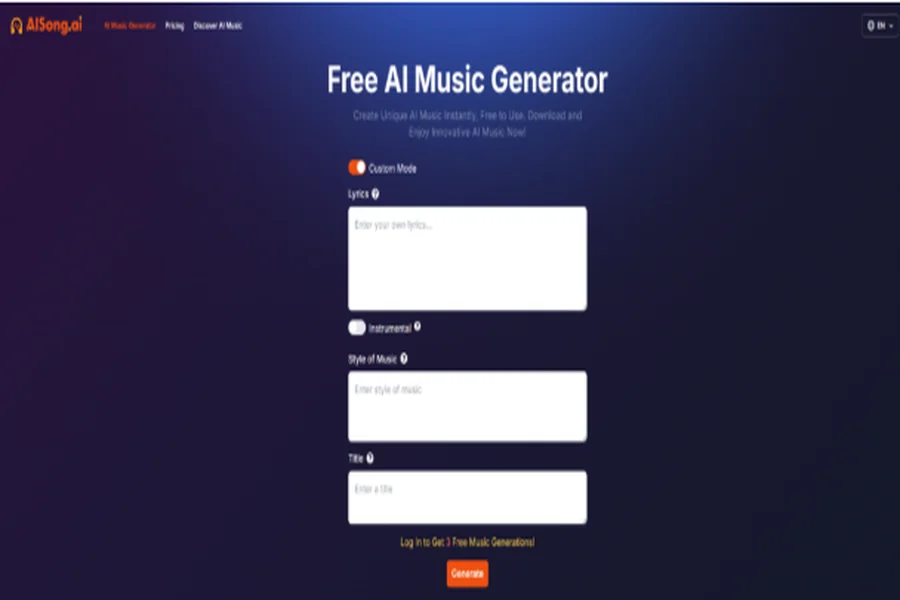
In my recent testing of the AISong.ai engine, I attempted to create a soundtrack for a very specific, niche scenario: A cooking video, but filmed in the style of a high-stakes action movie.
The Prompt:
“Orchestral staccato strings, intense percussion, ticking clock rhythm, sudden silence, then a triumphant brass finale. High tension, culinary battle.”
The Result:
A human composer would have charged me $500 and taken three days to deliver this. The stock library search would have yielded “Epic Action,” which is too generic.
The AI, however, generated a track in roughly 30 seconds that nailed the irony of the prompt. It had the intensity of a Hans Zimmer score but the playfulness required for the context.
I didn’t have to edit my video to fit a pre-made beat. I had a bespoke track that fit my narrative immediately. I finished the edit in an hour.
The Shift: From Scavenger to Architect
To understand the value proposition here, we need to look at the fundamental difference between “Finding” and “Forging.”
When you rely on existing libraries, you are a scavenger. You are limited to what others have already created. When you use generative tools, you become an architect.
Here is how the workflow shifts:
| Feature | The Scavenger (Stock Libraries) | The Architect (Generative AI) |
| Workflow | Search -> Filter -> Listen -> Settle. | Imagine -> Describe -> Generate -> Refine. |
| Creative Control | Passive. You take what is given. | Active. You dictate the tempo, mood, and instruments. |
| Revisions | Impossible. You cannot remove a flute from a WAV file. | Instant. “Regenerate without the flute.” |
| Narrative Fit | Accidental. You hope to find a match. | Intentional. You design the match. |
| Scalability | Linear. More music costs more money/time. | Exponential. Generate variations endlessly. |
The “Mood Board” for Your Ears
One of the most underrated uses of this technology is Pre-production.
Even if you plan to hire a real orchestra or a professional band for your final product, how do you communicate your vision to them? Saying “make it sound sad” is vague.
I have found that using generative audio as a “sketchpad” is incredibly powerful. You can generate five different versions of a theme—one piano, one synth, one acoustic—and present them to your team. “It should have the rhythm of Track A, but the instrumentation of Track B.”
It bridges the language gap between non-musicians and musicians.
Navigating the Fog: A candid look at limitations
As with any tool that feels like magic, it is important to inspect the gears. This technology is in its “teenage years”—full of potential, but occasionally awkward.
The “Lyrical Logic” Gap
While the AI can generate lyrics and vocals, it doesn’t always understand poetry. In my tests, if you ask for a song about “Quantum Physics,” it might rhyme “proton” with “crouton” if you aren’t careful. It works best when you provide your own lyrics or keep the themes broad (love, travel, energy).
Complexity vs. Chaos
There is a fine line between a complex song and a messy one. If you prompt for “Jazz, Metal, Opera, and Dubstep,” the AI will try its best to comply, but the result might sound like a musical car crash. The tool rewards clarity. It is better to ask for “Heavy Metal with Operatic vocals” than to throw every genre into the blender.
The “Human Swing”
Jazz and Soul music rely on “micro-timing”—playing slightly behind or ahead of the beat to create a groove. AI models are mathematically precise. Sometimes, this precision can make certain genres feel a bit “stiff” or “grid-locked.” It lacks the imperfect sway of a live drummer in a smoky room.
The New Creative Literacy
We are entering a time where “Prompt Engineering” is becoming a legitimate art form. Just as a photographer learns to see light, a modern creator must learn to describe sound.
It requires you to expand your vocabulary. You stop saying “I want rock music” and start saying “I want a distorted Les Paul guitar riff with a 1990s grunge aesthetic and a heavy snare drum.”
AI Song is not a replacement for human creativity; it is a challenge to it. It asks you: If you could hear anything you imagined, what would you imagine?
The barrier of technical skill has been removed. The barrier of budget has been lowered. The only thing left is your ability to articulate your vision.
Don’t let your best ideas die in the “WIP” folder because you couldn’t find the right song. Describe it, generate it, and finish it.