
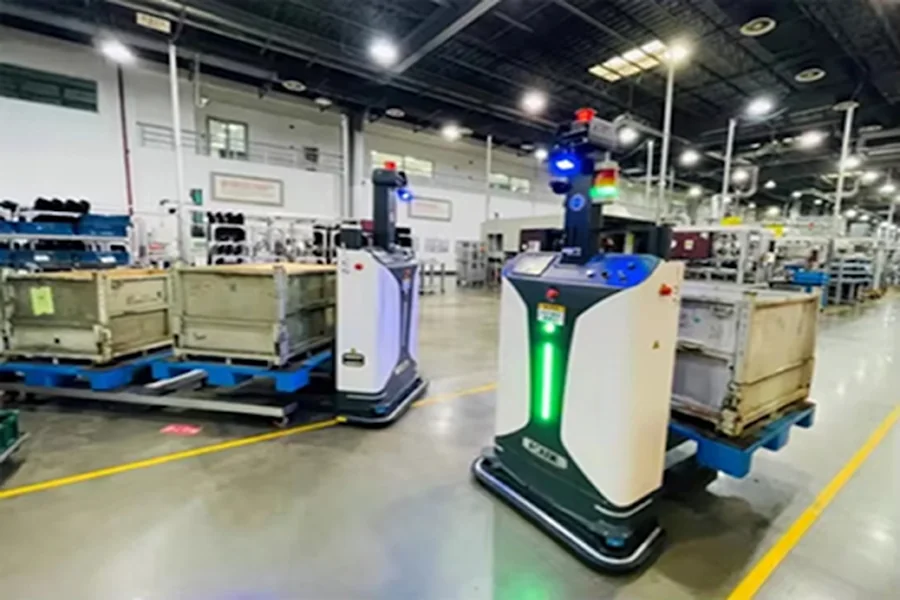
The automated guided vehicle industry stands at the threshold of a transformative power system revolution driven by two converging technological breakthroughs: solid-state battery architecture and wireless charging infrastructure. As material handling operations demand increasingly autonomous, efficient, and maintenance-free solutions, the limitations of conventional power systems become more apparent. Current AGV fleets, while substantially improved through modern lithium-ion technology, still require manual charging interventions, experience performance degradation over operational life, and face safety concerns inherent to liquid electrolyte systems.
The trajectory of AGV power system evolution reflects broader trends in energy storage technology, where incremental improvements in existing chemistries give way to paradigm shifts in fundamental architecture. Today’s advanced lithium battery platforms represent the culmination of decades of refinement in liquid electrolyte lithium-ion technology, offering exceptional energy density, cycle life, and safety characteristics that have enabled the current generation of compact, high-performance AGVs. Lithium iron phosphate (LiFePO4) chemistries deliver 120-160 Wh/kg with operational lives exceeding 3000-5000 cycles, providing reliable service in demanding industrial environments.
The specific operational requirements of automated guided vehicles make them ideal early adopters for emerging power technologies, particularly purpose-designed AGV battery systems incorporating next-generation capabilities. Unlike consumer electronics or passenger vehicles where cost and complexity constraints slow adoption of novel technologies, industrial AGV applications can justify premium pricing for solutions delivering superior total cost of ownership through extended runtime, reduced maintenance, and improved operational flexibility. AGV duty cycles characterized by predictable routing, controlled environments, and centralized charging infrastructure align perfectly with early-stage deployment of solid-state batteries and wireless charging systems.
Solid-State Battery Architecture: Beyond Liquid Electrolytes
Solid-state batteries replace the liquid or gel electrolyte found in conventional lithium-ion cells with solid materials—typically ceramics, polymers, or composite structures—enabling fundamental improvements across multiple performance dimensions.
Energy density advantages stem from the ability to utilize lithium metal anodes in solid-state configurations. Conventional lithium-ion batteries employ graphite anodes storing lithium ions intercalated between carbon layers at approximately 372 mAh/g theoretical capacity. Lithium metal anodes offer 3860 mAh/g—more than ten times higher—but form dangerous dendrites when used with liquid electrolytes, causing short circuits and thermal runaway. Solid electrolytes mechanically suppress dendrite formation, safely enabling lithium metal anodes. Combined with higher voltage cathode materials stable against solid electrolytes, solid-state batteries achieve energy densities of 350-500 Wh/kg compared to 150-250 Wh/kg for liquid electrolyte systems. For AGV applications, this translates to either:
- 50-60% battery volume reduction maintaining current runtime
- 2-3x operational runtime within existing battery compartments
- Flexible combinations of size reduction and runtime extension optimized for specific applications
Improved safety characteristics result from elimination of flammable liquid electrolytes. Conventional lithium-ion batteries contain organic solvents that can ignite if cells rupture or overheat, creating thermal runaway scenarios where adjacent cells sequentially fail in cascading failures. Solid electrolytes—particularly ceramic materials like LLZO (lithium lanthanum zirconium oxide) or sulfide-based glasses—remain stable at temperatures exceeding 200°C and cannot combust. This inherent safety reduces or eliminates requirements for complex thermal management systems, fire suppression equipment, and safety spacing between cells, further contributing to system-level volume and weight reductions.
Extended operational life emerges from several mechanisms. Solid electrolytes eliminate side reactions between liquid electrolytes and electrode materials that gradually degrade cell capacity over cycling. Mechanical stability of solid electrolytes prevents structural changes in electrodes during charge-discharge cycling that cause capacity fade in liquid systems. Early solid-state prototypes demonstrate 10,000-20,000 cycle capabilities—2-4 times longer than current lithium-ion AGV batteries—potentially extending battery service life to match or exceed AGV vehicle life, eliminating replacement costs entirely.
Fast charging capability accelerates as solid electrolytes support higher ionic conductivities and wider electrochemical stability windows than liquid alternatives. Some solid-state designs enable charging rates of 3C-6C (10-20 minute complete recharge) versus 1C-2C typical for liquid lithium-ion. This charging speed approaches or exceeds rates achievable through wireless charging systems, creating synergies when both technologies combine in integrated systems.
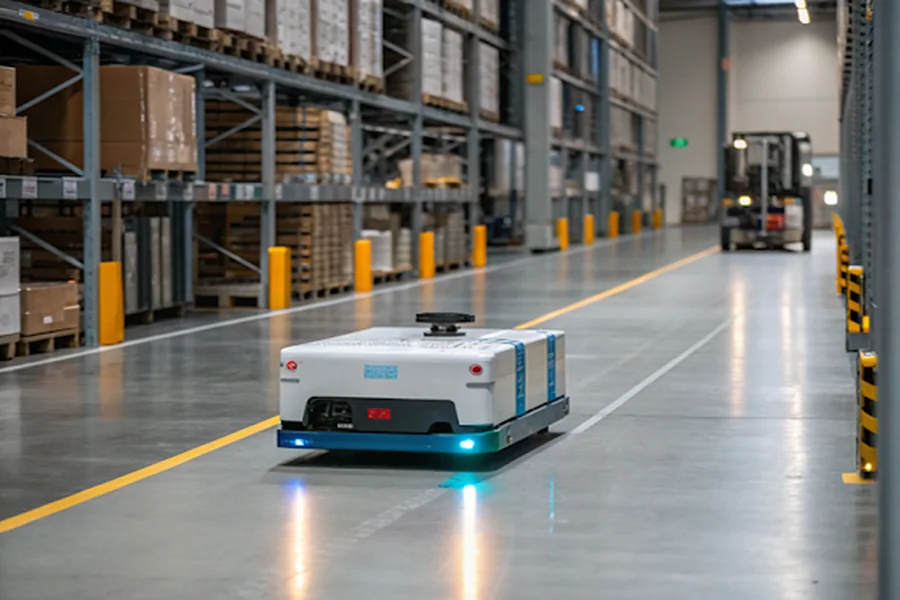
Wireless Charging Infrastructure: Eliminating Connection Complexity
Wireless or inductive charging systems transfer energy across air gaps through electromagnetic coupling, eliminating physical connectors and enabling completely automated charging operations.
Inductive power transfer fundamentals employ primary coils embedded in floor surfaces or charging pads energized with high-frequency AC current (typically 20-100 kHz). Secondary coils mounted on AGV undersides couple with the magnetic field generated by primary coils, inducing current that rectifies to DC for battery charging. Efficiency of modern inductive charging systems reaches 90-95% at air gaps of 10-50mm, approaching efficiency of conventional conductive charging while eliminating wear on physical connectors and reducing maintenance requirements.
Opportunity charging integration transforms AGV fleet energy management. Wireless charging zones positioned at strategic locations—assembly line endpoints, crossroad intersections, temporary storage zones—enable AGVs to automatically charge during brief idle periods of 30 seconds to several minutes. Vehicles position themselves over charging pads during normal operations without requiring dedicated charging station visits. This distributed charging approach maintains battery state-of-charge above 40-60% throughout shifts, avoiding deep discharge cycles that reduce battery life while ensuring vehicles always retain sufficient energy for assigned tasks. Key implementation considerations include:
- Dynamic power delivery adjusting charging rate based on available dwell time and battery state-of-charge
- Interoperability standards ensuring diverse AGV types operate on common charging infrastructure
- Foreign object detection systems preventing energy transfer when metal objects occupy the charging gap
- Alignment tolerance allowing successful charging despite vehicle positioning variations of ±50-100mm
- Multi-vehicle charging from single primary coil installations supporting multiple simultaneous AGVs
In-motion charging represents the ultimate wireless charging implementation where vehicles charge continuously while traveling along designated routes. Primary coils embedded in extended floor sections transfer power to moving AGVs, eliminating charging stops entirely. While technically challenging and expensive, in-motion charging suits high-throughput applications like airport baggage handling or automated warehouse cross-docking where vehicles must maintain constant motion. Power transfer efficiency at vehicle speeds of 1-3 m/s reaches 80-90% with proper system design, sufficient for continuous operation in demanding applications.
Synergistic Integration: Combined Benefits
The convergence of solid-state batteries with wireless charging creates multiplicative rather than merely additive benefits for AGV operations.
Reduced battery capacity requirements emerge as wireless opportunity charging maintains higher average state-of-charge, allowing smaller batteries to support equivalent operational demands. If wireless charging maintains battery charge above 50% versus 20% with conventional overnight charging, effective available capacity doubles without increasing actual battery size. Combined with solid-state battery energy density improvements, this synergy enables 70-80% battery volume reductions compared to current systems while maintaining operational capability.
Simplified battery management results from narrower operating windows. Batteries cycling between 40-80% state-of-charge experience dramatically reduced stress compared to 5-95% cycling typical with periodic charging. This narrow cycling range extends battery life, reduces thermal management requirements, and simplifies battery management system complexity. Predictable charging schedules and known charging locations enable BMS optimization impossible with variable charging patterns.
True autonomous operations become reality as vehicles manage energy independently. AGVs monitor their own charge status, navigate to charging zones during idle periods, and automatically position for charging without operator intervention. Fleet management systems optimize vehicle assignments considering charging infrastructure locations, ensuring vehicles near low battery states receive tasks near charging zones. This autonomous energy management represents the final step toward fully automated material handling systems requiring zero human intervention.
Market Adoption Trajectory
The path toward widespread solid-state battery and wireless charging deployment follows predictable stages based on technology maturity and economic viability.
Phase 1 (2024-2026): Early adoption in premium applications sees first-generation solid-state AGV batteries entering service in applications where performance advantages justify premium pricing—cold storage facilities requiring low-temperature operation, high-cycle applications like shuttle AGVs, and compact vehicles where volume reduction provides critical value. Wireless charging deployment accelerates in new facilities and high-throughput operations where rapid charging enables fleet size reductions offsetting infrastructure costs.
Phase 2 (2027-2030): Mainstream penetration occurs as manufacturing scale reduces solid-state battery costs to 1.5-2x lithium-ion parity while performance advantages justify the premium. Wireless charging infrastructure costs decline through standardization and competitive supply development. New AGV procurements increasingly specify solid-state batteries and wireless charging compatibility, while retrofit installations expand to medium-sized fleets.
Phase 3 (2031+): Market dominance establishes solid-state and wireless charging as default AGV power solutions, with liquid electrolyte batteries relegated to cost-sensitive applications and existing fleet support. Complete autonomy of AGV energy management enables radical operational innovations including just-in-time vehicle deployment and dynamic fleet sizing.
The convergence of solid-state battery and wireless charging technologies represents more than incremental improvement—it enables fundamental reconceptualization of AGV system design and operations. As these technologies mature over the coming decade, they will eliminate longstanding constraints on AGV performance and autonomy, unlocking new applications and operational paradigms that drive continued automation advancement across manufacturing, logistics, and material handling sectors worldwide.